
Summer reads, 2026

Summer is a beautiful time. When I sit in the sun, eyes shut, listening to the sound of distant lawn mowers or the babble of families picnicking in the park, it takes me back to a time when youth seemed eternal and whole days could be frittered away doing nothing but gazing at the endless sky. I still get a glimpse of that same feeling when I take a few days off to lie on a beach towel to read a book or two. So in that spirit, I’m sharing a few book recommendations with you. Summer books, mostly – by which I mean books that are enhanced by the feeling of sunshine on your skin.
Fiction
For me, reading in winter and summer are two entirely different experiences. In the winter I need something to wrap around myself like a blanket – a family saga, or a thick history of global events. But in the long, hot days of summer I want something that allows me to unfurl and daydream. Italo Calvino’s Invisible Cities does exactly that. It reimagines Marco Polo’s journeys through the cities of Kubla Khan’s vast empire. Each city represents a new idea, and each is more magical than the last. There is a city of the dead, another that exists on a spiderweb, and another that is constructed out of erotic fantasies. There’s even a city constructed entirely out of pipes and plumbing. It’s a slim novel, with very short chapters, but each one prompts you to stop, think and savour.
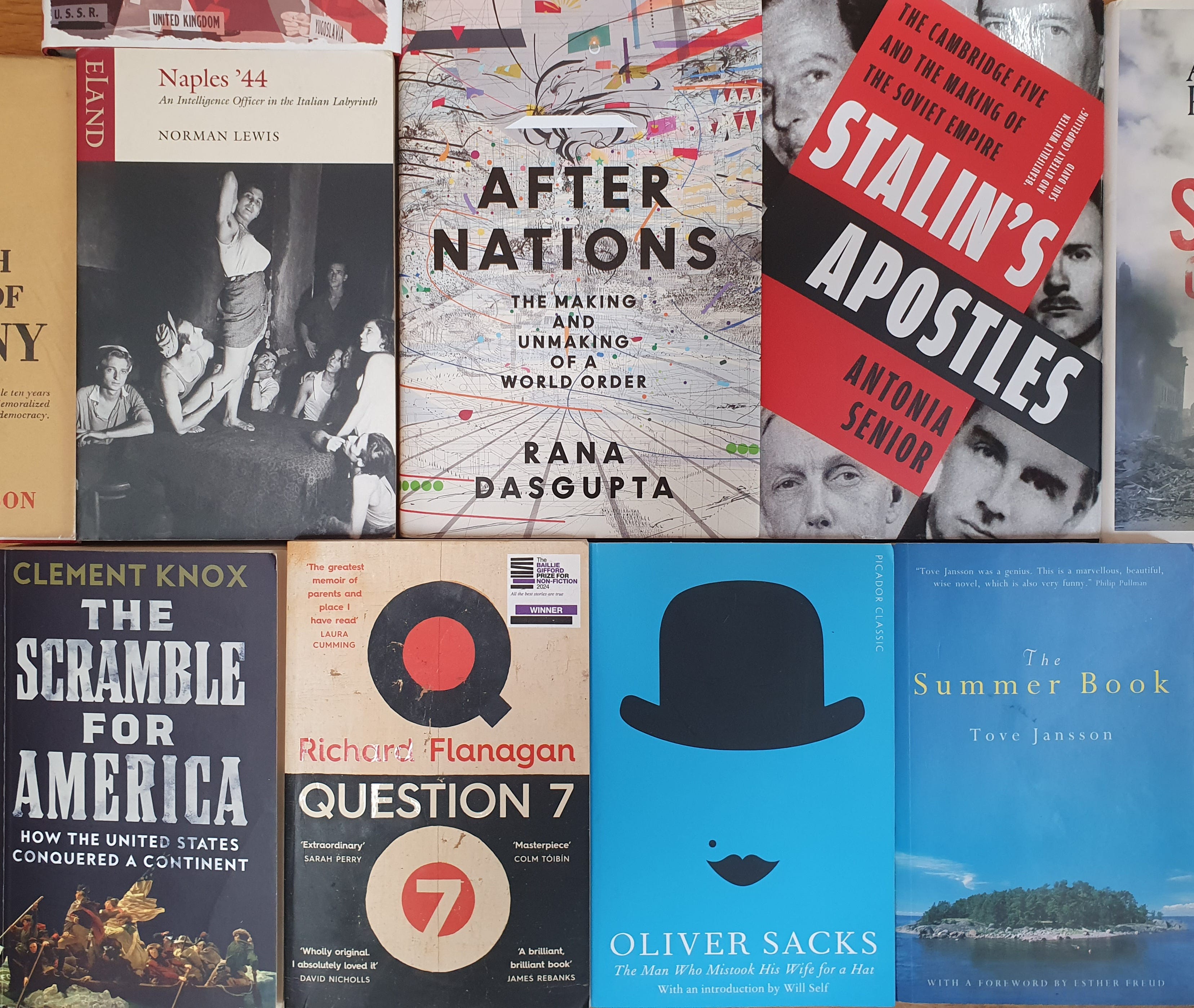
Tove Jansson’s The Summer Book is similar. It charts the relationship between a woman and her granddaughter as they summer together each year on a Scandinavian island. Essentially it’s a series of short stories, but somehow it manages to encompass the whole of human experience, from childhood wonder, through love and loss, to the eventual menace of death. It’s an astonishing book, dripping with sunshine.
While these are books for the heart and soul, Michael Frayn’s Skios is one for the mind. The novel begins with a balding academic arriving on Skios to give a lecture on the scientific organisation of science. But at the airport his luggage, and his identity, are stolen by a charming charlatan just out for a good time. From that point onwards the plot descends into a dizzying farce peopled with dozens of characters and at least half a dozen intertwined story lines. How on earth Frayn manages to squeeze all these springs into such a small box is mind-boggling; but the final explosion at the end is utterly satisfying.
Non-Fiction
It’s impossible to make a list of summer reads without mentioning Norman Lewis’s classic memoir, Naples ’44. I first read it some twenty years ago, and it was one of the inspirations for my own history of Naples during the Second World War. Lewis is a beautiful writer. He picks out the most emblematic moments from any situation, and opens a whole world of meaning with just a few words. He doesn’t let the truth get in the way of a good story – which makes using his book as a historical source tricky – but there is a deeper emotional truth to this book that feels much more important. Lewis lived in Naples during one of the most difficult periods in its 3,000 year history, and his love and compassion for the Neapolitan people shines out of every page. Much of his book is actually set in winter, but there is such warmth here that it always strikes me as a summer book nevertheless.
The same is true for Richard Flanagan’s Question 7, which I read last summer. It blew me away. Again, this is a memoir, but to think of it only in those terms seems unnecessarily reductive. It tells the story of H.G. Wells and his love affair with Rebecca West; of the atomic physicist Leo Szilard and his quest to discover the secrets of atomic fission; of the author’s own father who miraculously survived imprisonment in a Japanese labour camp; and of his own upbringing in the wilds of Tasmania. Somehow all of these stories, both history and memoir, are all a part of one another. Reading this book makes you feel connected not only to the author, but to life, the universe and everything. It rightly won the Baillie Gifford Prize in 2024.
Two for the heart, now one for the head. When lying in the sunshine contemplating life, there can be no more wondrous book than Oliver Sack’s classic, The Man Who Mistook His Wife for a Hat. This series of essays by a famous neurologist demonstrates what is so utterly remarkable about the human brain, and also the human spirit. There are stories here of cocaine addicts suddenly blessed with a sense of smell hundreds of times stronger than any human being; of shy, lonely old women being transformed into bright happy people by neurosyphilis; and yes, of a man who could not tell the difference between a woman and a hat. In an age of AI, where humanity is being reduced to a set of algorithms by people who seemingly have no appreciation for the true magic of human consciousness, this book is wonderfully life-affirming.
New books
Of the many history books that have landed on my desk over the past six months, three have grabbed my attention. The stand-out book has been Antonia Senior’s history of the ‘Cambridge Five’, Stalin’s Apostles. Full disclosure, Antonia is a friend of mine, but I would be recommending this book enthusiastically even if I’d never met her. She paints a brilliant portrait of each of these five British traitors, and then unleashes an unflinching condemnation of the appalling damage they caused not only to national security but to the lives of desperate people in eastern Europe. As Gore Vidal once said, whenever a friend succeeds, a little something in me dies – but when it comes to recommending Antonia’s beautifully-written, compelling book, a little death is worth it.
Rana Gupta’s After Nations is also utterly captivating. It asks the sort of questions most of us never think of. What are nations? Why do we even have them? What would the world look like without them? – because such a world might soon be upon us… The author’s main premise, which is that nations are basically an extension of capitalism, might not be to everybody’s political taste, but in places it is pretty difficult to argue with. His concluding chapter was also a great deal more hopeful about the future than I am, and I didn’t find it entirely convincing. But that’s not the point – this is a summer book, and it made me feel connected to a whole raft of ideas that have been floating around the back of my brain for years, but which I have never completely been able to catch hold of until now. That’s what summer should be about, shouldn’t it? Connection and illumination.
Finally, I have to mention Clement Knox’s recent book, The Scramble for America. It charts the building of the United States as a colonial project, much like the building of the British and French empires at exactly the same time. Strong research and really good writing makes this a compelling read. I often berate European friends of mine who complain about how ignorant Americans are when they come to Europe on holiday. And yet we Europeans are often just as ignorant about their country. This book is a wonderful antidote to that. It explains so much about the challenges that the USA faced in its infancy, and how that nation’s identity was born. I loved it.