
Syria
An emblem for our times

It is almost exactly a year since the end of the war in Syria. On 8 December 2024, after a surprisingly rapid advance on the capital, rebel forces finally entered Damascus. On the same day, the nation’s brutal dictator, Bashar al-Assad, boarded a plane bound for Moscow and fled for his life.
In this short article, I want to take a quick look at how Syria has changed since that historic moment. This Substack account is called “Aftermath” for a reason: my main area of study is what happens to nations and peoples in the wake of war, and events in Syria are a perfect contemporary example. But first of all I want to take stock of how things got to this point in the first place – because the tragedy of Syria is emblematic of our times in all kinds of ways.
The war in Syria began with a series of public protests back in March 2011, when pro-democracy demonstrators took to the streets to demand political change. These events were not unique to Syria: they were part of a region-wide uprising that became known as the “Arab Spring”. This outpouring of public resentment towards autorcratic rulers, and hopes for a freer, more democratic future, eventually led to the overthrow of several dictators. But it also sparked a series of civil wars across the Arab world.
In Syria the crackdown on dissenters was almost immediate. Thousands of demonstrators were arrested, tortured and murdered in the following weeks. In reaction, resistance militias formed across the country, supplied with weapons by sympathetic foreign governments. As a consequence, the violence that broke out was extremely complicated right from the beginning. It involved people who were rebelling for ethnic and religious reasons as well as straightforwardly political ones, along with outside forces who were meddling in Syrian affairs for their own motives.
The violence quickly got out of control and spread to all corners of the country. Terrified of what was happening, millions of people decided to flee – some on foot, some in ricketty boats heading for the Greek islands.
This sudden migration took Europe completely by surprise. At first Europeans were mostly compassionate – Germany, for example, offered to give asylum to a million people. But in the coming months the loudest voices were fearful, reactionary and, frankly, racist. Populist governments in eastern Europe refused to take more than a few thousand refugees each, and stipulated that they should be Christians, not Muslims. Suddenly barriers started appearing all over Europe – particularly in Hungary, which erected a wall to keep the refugees out. If you are looking for the moment when Europe’s current moral and existential panic about immigrants first began, this was probably it.
Very quickly, the civil war became a proxy war between different parts of the world with different agendas. While the West generally supported the rebels in the hope that some kind of democratic state might arise, Putin’s Russia steadfastly supported the Assad regime. Not only that, but it enthusiastically joined in with Assad’s atrocities. Russian planes bombed Syrian civilians using cluster bombs in direct contravention of UN resolutions. They also bombed at least eight civilian hospitals, almost certainly deliberately. War crimes committed by Russian troops in support of Assad are simply too numerous to list here. The important point is that the civil war demonstrated unequivocally the vast gulf that lay between Russia and the Western democracies, and also laid down the template that Russia would use in its war against Ukraine years later.
Russia was not the only power to support Assad. Iran, the greatest player in the region, also joined the fray. Here was an overt coalition between autocratic regimes – yet another phenomenon that has become emblematic of our times.
In the midst of this chaos, terrorism flourished. An Islamic State took hold in the borderlands between Syria and Iraq (indeed, the very name that has become synonymous with Islamic terrorism in our times – ISIS – actually stands for “Islamic State in Iraq and Syria”.) The war of all sides against ISIS added a whole new dimension to what was already a tragedy. It effecitvely became a war within a war.
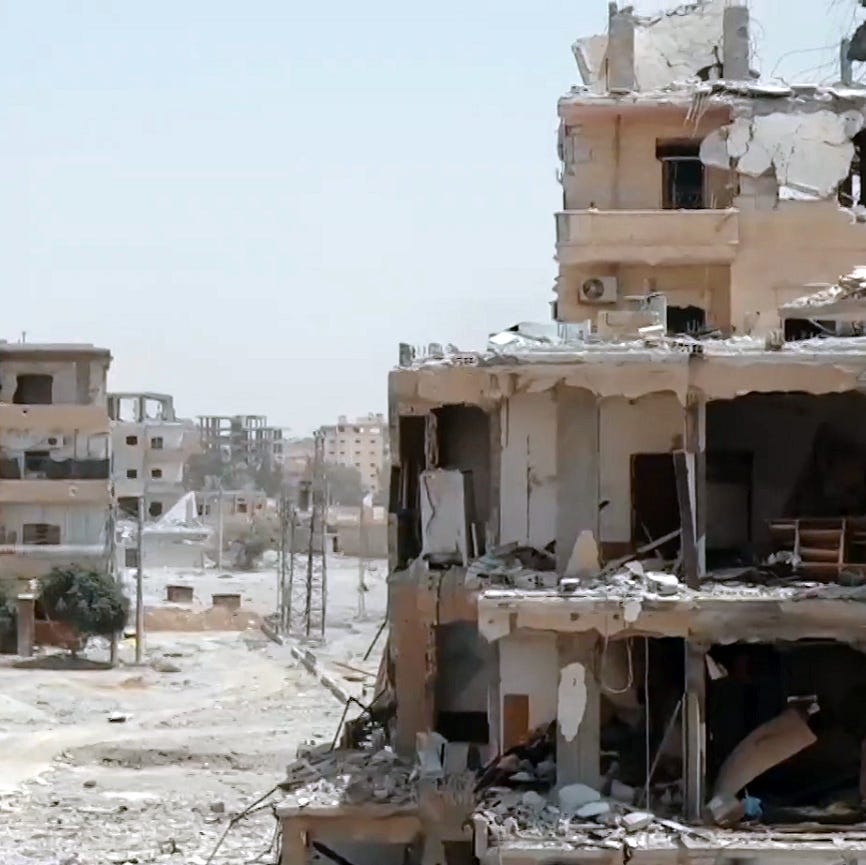
While terrorism flourished, however, so too did heroism. In the ruins of cities like Aleppo and Idlib, thousands of volunteers formed civil defence groups – not to fight, but to rescue people from the rubble. In order to distinguish themselves as non-combatants they wore white helmets. But soon these heroic civilians themselves became targets, as Russian and Syrian forces deliberately tried to wipe them out. To cover up this cynical operation, a massive disinformation campaign was launched against them, dubbing the White Helmets as terrorists in disguise.
In summary, the tragedy in Syria has symbolised many of the greatest movements of our time: the Arab Spring, the refugee crisis, Europe’s panic over immigration, the gloabl rise of autocracy, increasing disregard for the international rule of law, more war, more atrocity, more injustice – and all of it covered up or excused by industrial levels of internet trolling and disinformation, particularly by Russia.
Despite all of this, Assad still lost. The only reason he is not facing arrest today is that Putin continues to shield him. It is Putin’s Russia that blocked his indictment by the International Criminal Court by using its veto in the UN Security Council. And it is Putin’s Russia that has given him asylum.
(I hate to come over as all anti-Putin in an article that is supposed to be about Syria – but as I hope I’ve made clear, what happened in Syria is emblematic of our times. This is just another demonstration of the fact one of the greatest de-stabilising influences in the world today is Vladimir Putin and his anti-democratic regime.)
So, what of today?
The forces that finally liberated Damascus this time last year were only one particular faction of the rebellion. They were a group called Hayat Tuhrir al-Sham (or HTS) and their leader, Ahmed al-Sharaa, has since been appointed Syria’s interim president. Not everyone is particularly happy about this. Until recently HTS was classified by the UN as a terrorist group, and Sharaa himself was once a footsoldier for al-Qaida. Today he claims that all of this is behind him, and he seems to have become much more moderate since taking charge. But even so, his militant background makes Syria’s many other ethnic and religious groups understandably nervous.
In March this year, all their greatest fears about the new regime appeared to be coming true. A wave of vengeance and sectarian violence swept over several regions of the country – especially Syria’s coastal areas, which are home to the Alawite Muslim minority, and the south, which is home to the Christian Druze minority. Hundreds upon hundreds of people were massacred here by troops and militias allied to the new government, and a hail of international condemnation quickly rained down upon Sharaa and his fellow leaders.
