
The Sunset March

Two weeks ago, while visiting the Dutch city of Nijmegen, I took part in an extraordinary commemoration of the Second World War. It was simple but powerful, small but at the same time gigantic, and while humble in concept it involved high-tech engineering that cost hundreds of millions of Euros. I’ve never seen anything similar, despite being involved in WWII remembrance for years. So I thought I should write about it here.
Before I get into the ceremony and its beautiful poignancy, it’s important to outline exactly what happened in Nijmegen 80 odd years ago. In September 1944, this city stood right at the centre of a new war zone. To the east, the forces of Nazi Germany were ranged behind an impressive set of defences, the so-called Siegfried Line: hundreds of miles of ramparts, bunkers, tunnels and tank traps that stretched all the way from the Netherlands to Switzerland. To the west stood the Allies. They were exhausted after several months of fierce fighting from the beaches of Normandy to the borderlands of Germany. Their logistics were stretched, their men were tired, but they were determined to press on towards Berlin and end the war as quickly as possible.
For the Allies, the big problem was how to get the war moving again. The Supreme Allied Commander, General Eisenhower, favoured a general attack across the whole front, gradually exhausting the Germans until it might be possible to break through. His subordinate, General Patton, was much more aggressive: he wanted to concentrate their forces at one point and punch through the Siegfried Line and into Germany.
But the British commander, Field Marshal Montgomery, suggested something different. Rather than go through the Siegfried Line, why not bypass it altogether? The Germans had not built such heavy defences at the northern end of their border because they did not feel that they needed to. The Netherlands was criss-crossed by several huge rivers – the Maas, the Waal and the mighty Rhine – which were formidable barriers in their own right. But if Montgomery could somehow secure the bridges over these rivers, he would have a straight run into northern Germany. His plan was to drop tens of thousands of airborne troops around these bridges to secure them (Operation Market), and then send a ground force up through the Netherlands to link up with them (Operation Garden). Easy.
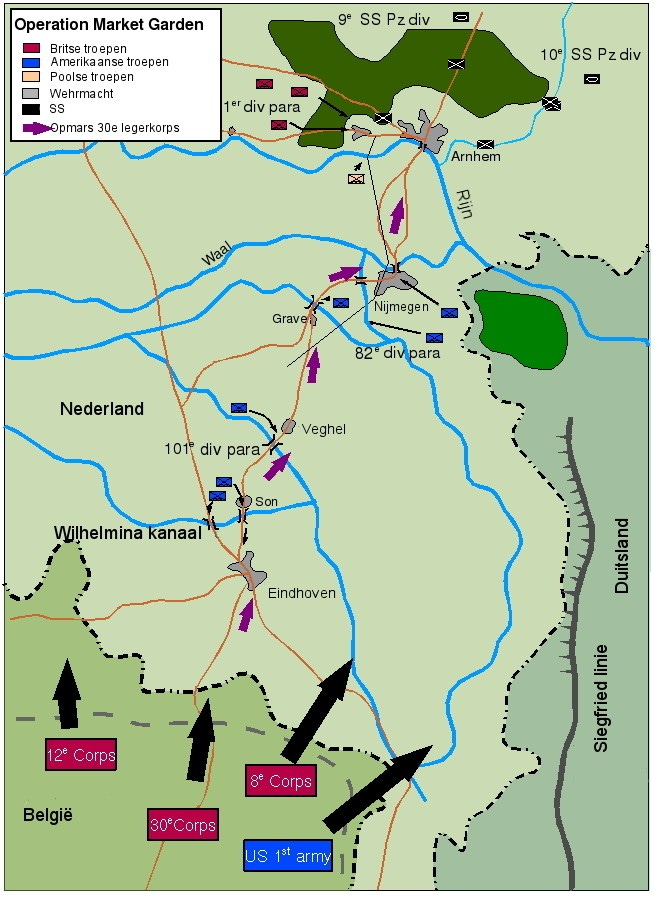
So began one of the most ambitious – and doomed – operations of the latter stages of the war. The final objective was the bridge over the Rhine at Arnhem, without which the whole of the rest of the operation would be worthless. But in order to get there, the Allies had to take a whole series of other towns and bridges along the way. Two of those bridges were at Nijmegen, and it was here that the plan began to unravel.
The problem was that this battle was not only a conventional conflict over ground – it was also a race against time. The Allied forces had to get to Arnhem quickly, in order to relieve the brave paratroopers who had already seized that final, all-important bridge. But all the Germans had to do was delay them: sooner or later, the paratroopers at Arnhem would run out of men and supplies and, once that happened, the whole thing would be over.
And so a mighty battle developed here, in Nijmegen, the central node that blocked the way through to Arnhem. At first the Allies tried to seize the Nijmegen bridges in a straightforward, frontal attack – but the defences were so strong that they could not get to them. So instead they sent troops across the river in boats to try to capture the bridges from the north side. In broad daylight, hundreds of brave men from the US 82nd Airborne Division climbed into flimsy canvas boats and set off across the river, which at this point was some 300 metres wide. The Germans watched them all the way, and pounded them with tanks, artillery and relentless machine gun fire.
“It was a horrible, horrible sight,” remembered Giles Vandeleur, a British officer who witnessed the crossing from the south bank. “Boats were literally being blown out of the water. I could see huge geysers of water shooting up as the shells hit the water, and the small arms fire coming in from the northern bank made the river look like some sort of seething cauldron.”
According to Antony Beevor, of the 26 boats that made the initial crossing, only 11 returned to collect the second wave. Forty-eight paratroopers were killed in this crossing alone, and dozens more wounded.
In the following hours more men crossed the river. The northern bank was secured and the bridge was finally taken. Now the Allies were free to press on to Arnhem, but it was already too late. The bridge at Arnhem proved to be the “bridge too far”, and the whole operation failed when the brave paratroopers at the far end of the operation finally had to surrender. In the end, Operation Market Garden was an expensive failure which cost the lives and the liberty of thousands of the Allies’ bravest and best trained men.
